
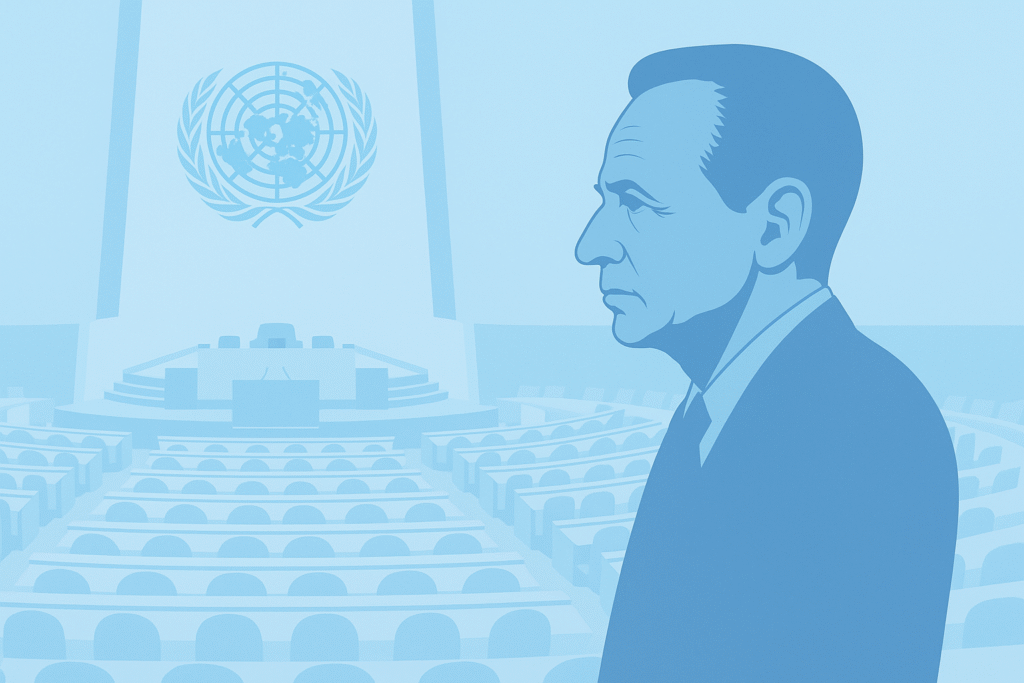
Independent Civic Initiative Inspired by the Ethical Legacy of Dag Hammarskjöld
Reviving the Moral Courage of the United Nations
“The UN was not created to take mankind to heaven, but to save humanity from hell.”
– Dag Hammarskjöld
Dag Hammarskjöld (1905-1961) served as the second Secretary-General of the United Nations. A Swedish economist and statesman, he strengthened the UN’s independence and capacity for peacekeeping. His leadership combined integrity, discipline, and deep ethical conviction, qualities that continue to define the UN ideal of service above self.
The United Nations Charter is the founding document and moral compass of the international community. Signed in 1945, it functions as the closest thing the international community has to a constitutional framework, a covenant between nations that defines how power should be exercised, how conflicts must be resolved, and how dignity and sovereignty are to be protected. Its words carry the collective promise of 193 Member States to uphold peace, justice, and cooperation. But a promise is only as strong as the will to honour it. It is incumbent on us all to adapt and use the tools at our disposal to help ensure that the United Nations works for all peoples and nations.
The Spirit of Dag is an independent Switzerland-based civic initiative. It is inspired by the ethical example of Dag Hammarskjöld and dedicated to practical, Charter-aligned ideas that can strengthen the credibility, discipline, and usefulness of the United Nations in a turbulent international environment.
This initiative has no institutional affiliation with the Dag Hammarskjöld Foundation or the United Nations.
Practical Priorities
The Five Actions for 2026
The Five Actions are practical, Charter-consistent proposals intended to strengthen the moral authority and operational credibility of the United Nations. They are not abstract slogans. They are disciplined, achievable steps that speak to prevention, restraint, accountability, and the protection of civilian life.
1 · Veto Restraint in Atrocity Cases
A voluntary pledge for permanent members of the Security Council to refrain from using the veto when mass atrocities are at stake. This ensures that the world’s response to genocide and war crimes cannot be silenced by a single vote. Veto restraint restores the moral legitimacy of the Council and rebalances the idea of collective responsibility. In the face of suffering, silence is complicity.
Read more →2 · Peacebuilding Fund – Rapid Mediation Window
Expanding the UN Peacebuilding Fund to include a dedicated rapid-response mediation window. This enables qualified mediators to deploy within days, when words can still prevent wars. Quick, quiet diplomacy saves lives and resources before conflicts spiral into full-scale crises. In mediation, timing is everything. Peace must always move faster than war.
Read more →3 · Humanitarian Carve-Outs in Sanctions
Ensuring that sanctions never block the delivery of life-saving humanitarian aid. Sanctions should restrain aggressors, not starve civilians. Standardized carve-outs across all UN resolutions protect aid workers, medical suppliers, and relief financiers. Sanctions without compassion erode the very values they claim to defend.
Read more →4 · Ceasefire Services Package
Integrating essential civilian recovery services into UN ceasefire agreements. Electricity, water, and medical logistics become peace dividends, incentives that make truces hold. By connecting peacekeeping with immediate infrastructure relief, ceasefires become self-reinforcing. The future of conflict resolution lies in tangible peace, not abstract promises.
Read more →5 · Accountability & Renewal
Creating an annual accountability cycle across all UN agencies and missions. Every entity publishes a short “Integrity Report”, measuring progress, transparency, and impact. This rebuilds public trust and internal discipline, aligning UN performance with its founding ethics. Renewal begins with honesty. Accountability sustains it.
Read more →